Art Therapy: Changing the Legacy of Our Daughters
Changing the Legacy of Our Daughters
For the last 75 days, I have been in intensive trauma therapy at a Christian residential treatment center. This is my third stay here in three years. By the time I leave this time, I will have spent approximately six months of my life away from my home and my children, putting in the difficult work of healing from complex trauma. Six months is a long time to be away from the people and the life you love. But healing takes work—sometimes painful work, sometimes exhausting work, and sometimes, unexpectedly, that work begins with nothing more than a blank sheet of white paper, a pair of scissors, some glue, and a stack of old magazines.
One of the programs offered here is art therapy. As someone who has always been creative, it is one of the therapeutic modalities that resonates with me most. The neat thing about art therapy is that the goal is not to make something beautiful. The value is in the process of creating, which can help us express and explore emotions, memories, and experiences that may be difficult to put into words. Artmaking can involve visual, sensory, motor, emotional, and cognitive processes at the same time, and different materials create different sensory and physical experiences. Drawing with a pencil feels different from working with paint, pastels, clay, or—as I learned today—tearing apart magazines and putting the pieces back together again.
For trauma survivors in particular, art can provide a way to externalize something that has lived internally. Instead of always having to begin with Tell me what happened, sometimes we can begin with a color, a texture, an image, a word, or a metaphor. The finished piece can become a visual representation of thoughts and emotions that we may not have known how to express before we began creating.
Today, our assignment was incredibly simple. We were told to create whatever came to mind. There were no elaborate instructions and no particular outcome we were supposed to achieve. We were simply supposed to create.
I started where I almost always start: words. Words are often the beginning of my creative process. Before I know exactly what something will look like, I begin collecting words, ideas, emotions, and associations. In design, this is similar to mind mapping—beginning with a central idea and allowing related words, images, thoughts, and concepts to branch outward. You don’t necessarily have to know where you are going when you begin. You simply pay attention to what connects.
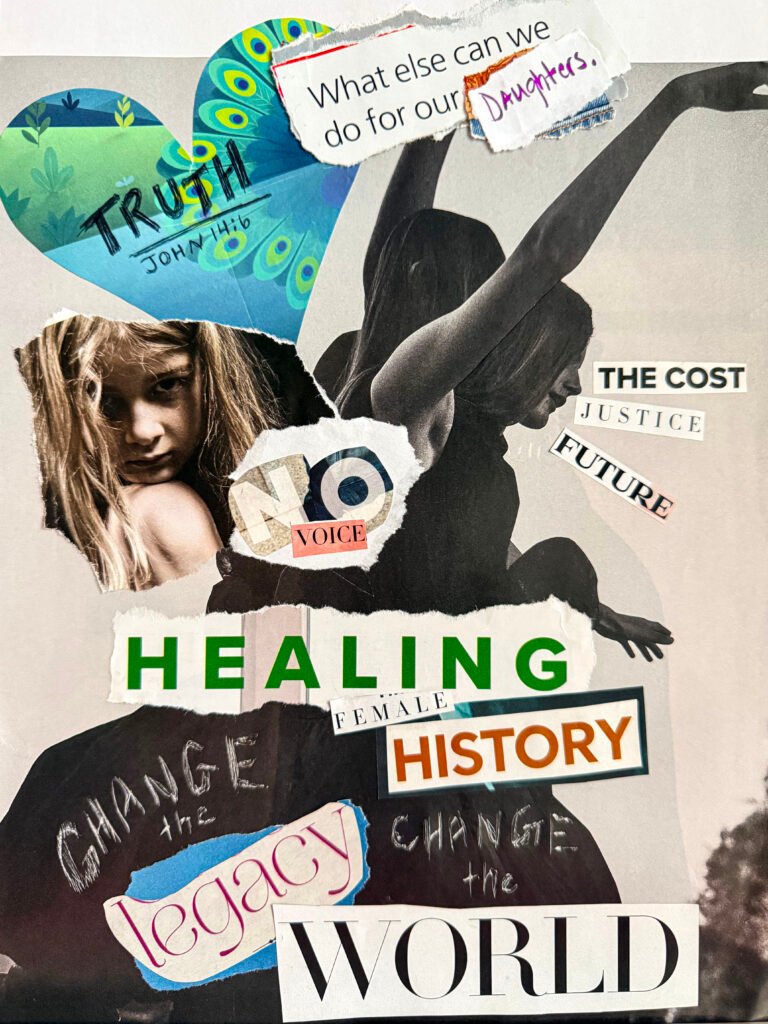
So I started flipping through the magazines. If a word or phrase made me stop, I cut it out or tore it from the page. I didn’t have a plan yet. I simply paid attention to what caught my eye. The first phrase that stopped me was, “What else can we do for our children?” I immediately cut it out, but as I looked at it, children wasn’t the word that belonged there.
My heart has been so focused on my own trauma, the stories of the wounded women I have met here, and the work I have been doing to build altogether beautiful. that I knew exactly what I wanted it to say. I covered the original word and wrote “Daughters.” What else can we do for our daughters? That question became the heart of the entire piece.
As I continued flipping through the magazines, more words began finding their way onto the page: history, healing, female, legacy, world, justice, and future. I wasn’t intentionally trying to tell a story at first, but as I placed the words and images together, a story began emerging on its own.
In the background, I placed an abstract image of what appears to be two girls with their arms raised. Depending on how you look at it, it almost creates the illusion of one girl in motion. To me, they look as though they are dancing or running. Something about this image immediately made me think about my daughters when they were young—the freedom and innocence of young girls before adulthood, before life has had the opportunity to wound them or tell them who they should be.
Then I found the image of the younger girl. She looks sad, and something about her expression made me think of all the girls whose innocence has been taken from them through abuse, exploitation, violence, or trauma before they were even old enough to understand what was happening to them. Beside her, I placed the words “NO VOICE.” Because when we experience trauma, specifically abuse, as young girls, we are often taught that our voices don’t matter. We don’t have the power or the language to explain what is happening, sometimes we don’t even understand that what is happening to us is wrong. We have a story, but we don’t yet have the voice to tell it—or we have learned that speaking up can feel more dangerous than staying silent.
But then my collage moves from the little girl to the background image. The girls arms are raised and appear to be moving freely. Beside one of them I placed the words “THE COST,” “JUSTICE,” and “FUTURE.” I deliberately positioned those words so they appear almost as though they are coming from her mouth, because the little girl who once had NO VOICE eventually becomes a woman who does.
She can finally say what happened. She can tell the truth about what it cost her. She can demand that what happened to her matters. She can seek justice—not only for herself, but for the girls who still do not have a voice. Perhaps most importantly, she can use her voice to help create a different future for the daughters coming behind her.
Near the center of the collage are three words that became incredibly significant to me: HEALING — FEMALE — HISTORY. There is a cost to carrying trauma, but there is also a cost to healing it. Healing requires us to return to places inside ourselves that we may have spent years trying to avoid and connect to the emotions we were not able to fully experience while it was happening. It asks us to look honestly at our history and name the wrong that has been done to us. Dr. Timothy Jennings, Executive Clinical Strategist and Teaching Psychiatrist at Honey Lake Clinic and founder of Come and Reason Ministries, says, “Once there is woundedness or brokenness of any kind, there are no pain-free options. There’s only healing or not healing.” Essentially, once we have been wounded, avoiding the pain does not make it disappear. We can choose to do the painful work of healing, or we can continue carrying the pain with us.
At the bottom of the collage, I placed two final words: LEGACY and WORLD. Above them, instead of neatly cutting out more letters, I physically scratched the words “CHANGE THE” into the background. That part of the piece matters to me because I could have found prettier words. I could have made that section clean and polished. But healing isn’t always clean and polished. In fact, working through the wounds of trauma can be a lot like a doctor cleaning an infected wound. To properly clean it, the doctor has to brush over the very places that hurt and remove what is preventing the wound from healing. Trauma can be similar—we have to feel the painful places and carefully work through what is there so the wound can finally begin to heal.
Sometimes change has to be scratched into the story. There is something symbolic about physically etching into an image—you have to damage the surface in order to permanently alter what was there before. That felt like an appropriate representation of healing. Changing what has been passed down can hurt. It requires confronting things we would rather leave untouched, but sometimes we have to disturb what has always been there if we want the story to end differently. Change the legacy. Change the world.
But perhaps the most important piece of my artwork is the heart at the top of my collage, with the word TRUTH written across it and the words of Jesus from John 14:6: “I am the way, and the truth, and the life.” I intentionally chose a heart instead of a cross. The cross is sacred to me and central to my faith, but it can also represent religion—and unfortunately, religion has sometimes been used in ways that keep women in bondage. Scripture can be misused to encourage women to remain silent, endure mistreatment, submit to control, or believe that continuing to suffer abuse is somehow an act of faithfulness. I didn’t want the focus of this piece to be on religion. I wanted it to be on the heart and character of God—who He is and what His love actually looks like.
The heart represents truth and love, because abuse has a way of distorting both. Healing requires recognizing those lies and replacing them with truth—the renewing of the mind and learning to “take every thought captive to the authority of Christ” (2 Corinthians 10:5). Was it my fault? Did I deserve it? Is this really love? Scripture gives us a truth outside of both the abuser’s interpretation and the survivor’s wounded perception against which those questions can be measured.
But there is another reason I wrote TRUTH across the heart. Scripture speaks of God writing His law upon the human heart (Jeremiah 31:33; Hebrews 10:16). I believe there is something profound about the way our hearts, minds, and even our bodies respond when we are violated. We were created by a holy and loving God, made in His image, and we were not created for abuse, exploitation, degradation, or violence. The pain of trauma bears witness that something has happened to us that was never meant to be, and it cries out, “This is wrong!”
To me, that cry reflects the truth of God written upon the heart. The pain does not mean there is something wrong with the person who was harmed; it reveals that something wrong was done to her. Sin wounds what God created for goodness, dignity, holiness, and love. And God is not indifferent to that suffering. Scripture repeatedly reveals a God who draws near to the brokenhearted, sees the afflicted, and grieves over evil. The pain of abuse, then, can become a witness to truth: this is not what love was created to be.
When I stepped back and looked at the finished collage, I realized this wasn’t simply a piece about my trauma. It wasn’t even only about healing. It was about daughters—mine, yours, the little girl I once was, the wounded women I have spent these months sitting beside, the girls who haven’t found their voices yet, and the generations of daughters who will come after us.
Maybe part of healing our own history is realizing that healing doesn’t have to end with us. When a woman tells the truth about what happened to her, refuses to carry shame that was never hers to begin with, discovers who God created her to be and learns to see her identity and worth through His eyes, finds the voice she once didn’t have, and does the painful work of healing, she changes something beyond herself. She changes what the next generation sees, hears, learns, and inherits.
And maybe that is one of the answers to the question that started this entire piece: What else can we do for our daughters? We can heal. We can speak. We can tell the truth. We can use our voices for the women and girls who haven’t found theirs yet. We can confront the history behind us so that it does not have to become the future in front of them.
If enough women are willing to do that—one story, one voice, one daughter at a time—perhaps we really can change the legacy and, in doing so, change the world. And that is what I hope to encourage through altogether beautiful.—women finding the courage to tell their stories, reclaim the truth of who God created them to be, and allow their healing to become part of the healing of the generations that come after them.
