
How he looks on the outside, is oftentimes how I feel on the inside.
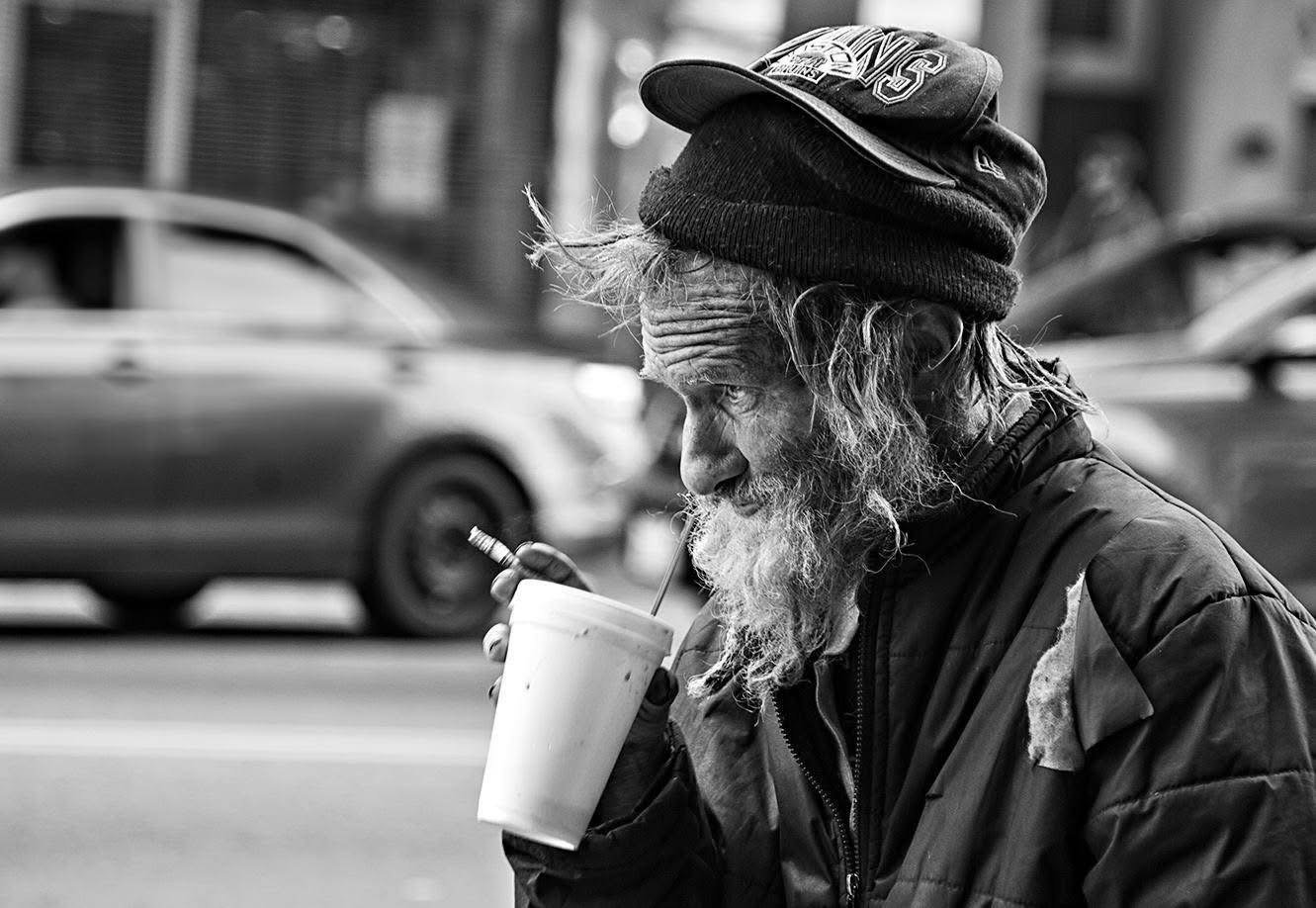
Chris Farley, Street Photography and Photojournalism (FB Group)
Journal Entry, Art as Communication (Liberty University)
I’m particularly interested in black and white photography, specifically street photography, so I often peruse Facebook groups dedicated to posting those types of images. As my finger swiped past dozens of photographs depicting various street scenes my mind felt slightly bored until my eyes landed on this image of a homeless man with his right hand full, with both, a drink and cigarette.
At first, my mind cognitively dissected the image…I love the contrasting shadows and highlights. I wondered why, as a former smoker myself, that he wasted a perfectly good drag from his cigarette and let it go to ash. And then, the double hats? The winter hat beneath a summertime ballcap? Then my eyes dropped down to his left shoulder to the rip in his coat. That rip summoned an emotion to rise that was deeper than the emotion of pleasure and curiosity that I experienced at first glance of the image.
I’ve spent the last 4 years in therapy and at the onset of that emotion, I ventured down the path of “Trigger-Feeling-Meaning,” a self-reflection process that helps identify the deeper meaning of an emotional experience. As I dove into the process…Trigger- the rip in the man’s jacket. Feeling- sadness. Meaning- the jacket reminds me of one I had when I was little and the rip in this man’s jacket made me think of the pain that was ever present when I was young. And that is when I truly started to experience the photo rather than just observe it.
I then began to study the man’s face. At first glance, for most, and I say most because of the comments I’ve heard over and over from those describing the homeless; he is lazy, a loser, a freeloader, etc. But when I see the stress lines across his face, his matted hair, and the loneliness in his eyes I can’t help but think that…how he looks on the outside, is oftentimes how I feel on the inside. Exhausted, rundown, dirty, worthless, trash, homeless, LONELY!
And if my heart looks that bad on the inside, I can’t even imagine the state of his.
And that thought moves me to the deepest places of my own pain and how unbearable of an experience that is and can’t help but feel immense compassion for the unbearable emotions he must experience in the deeper parts of his soul.
I think this is where Weichbrodt’s idea of loving vision comes into play. As I continued looking at this man, I began to see something far more important than his outward appearance. Possibilities of things he may have experienced flashed across my mind and a deep sense of compassion flowed over me. I couldn’t help but want to know more about this man, just as I do with my own street photography. I wonder if the photographer was also drawn to this man in the way I was, and if that is what moved him to stop and capture that moment?
I think for me, transforming vision isn’t necessarily about changing how I see people, but reaching into those deeper places of my own heart and stirring an even greater desire to understand theirs, so that I can be an advocate for them. I guess, because of my own experiences I have always held compassion for those who are suffering, especially those who are misunderstood or judged. I’ve always wondered how differently we might treat one another if, like Jesus, we sought to know the heart of our neighbor rather than make assumptions about who they are. Then, maybe, we wouldn’t be so quick to cast them away.
“For the LORD sees not as man sees: man looks on the outward appearance,
but the LORD looks on the heart.” – 1 Samuel 16:7
